Delimbiyr Vale
General Info
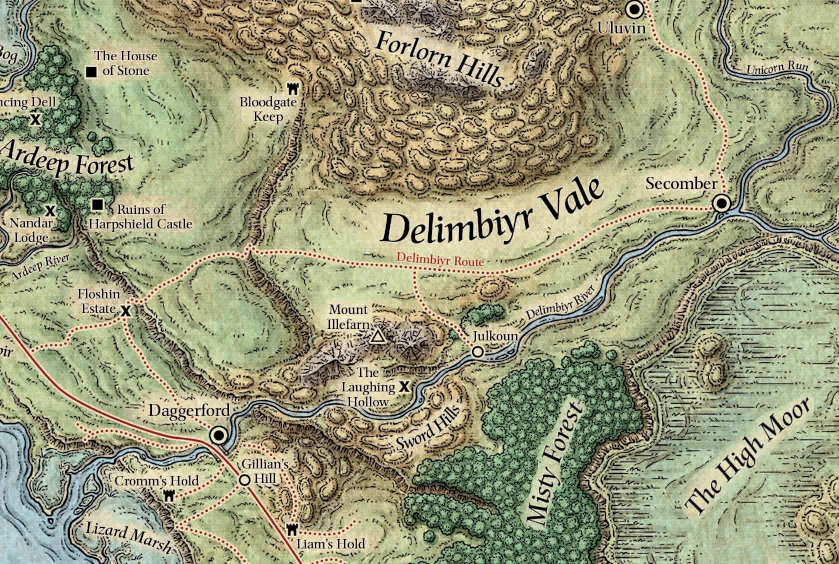
The Delimbiyr Vale — sometimes called the Shining Vale — is a fertile, river-cut valley in the Western Heartlands of Faerûn, stretching along the winding Delimbiyr River between the High Forest to the east and the Sword Mountains to the west. Once the heart of the long-fallen elven realm of Eaerlann, the Vale today serves as a crossroads between north and south, civilization and wilderness, trade and ruin.
Merchants and adventurers alike travel the ancient Trade Way and Delimbiyr Route through this lush valley, unaware that beneath its quiet fields and ruins lie the buried echoes of elven cities and dwarven halls.
Geography
The Delimbiyr Vale is defined by the Delimbiyr River, which flows westward from the High Forest, cutting through gentle farmlands and low-lying hills before emptying into the Dessarin River near Daggerford. The region enjoys a temperate climate with mild winters and fertile soil, making it one of the most agriculturally productive valleys of the North.
Notable Regions
- The Gray Vale – The eastern end of the Delimbiyr basin, a land of scattered baronies and ancient ruins, bordered by the High Forest and Nether Mountains.
- The Misty Forest Edge – A wild southern stretch of the Vale where elven settlements hide among ancient trees.
- The Western Vale – A broad and well-travelled corridor near Secomber, where human and halfling communities thrive.
- Eaerlann’s Ruins – Crumbled remnants of the ancient elven realm that once spanned much of the valley.
Geographical Features
- Delimbiyr River – The lifeblood of the Vale, navigable by small craft, lined with farms, barge towns, and overgrown ruins.
- Grayflow Tributary – A swift stream from the High Forest, famed for its silver-gray fish and icy clarity.
- High Moor – A treacherous, fog-shrouded upland south of the river, home to monsters and the ruins of elder civilizations.
- Unicorn Run – A sacred river to the north, said to be blessed by the fey and guarded by unicorns and dryads.
- The Shining Falls – A magnificent cascade at the eastern end of the valley where the Delimbiyr begins, glimmering with magical light at moonrise.
Major Cities and Settlements
- Secomber — A tranquil riverside town at the western edge of the Vale, built atop the ruins of Eaerlann’s ancient capital.
- Loudwater — A fortified trade town near the High Forest; once a stronghold of the Gray Vale baronies and now a bustling center of commerce.
- Llorkh (Ruins) — Once a mining and trading town turned tyranny under Zhentarim rule; now mostly abandoned, haunted by its past.
- Highstar Lake Villages — Small fishing and farming communities dotting the upper reaches of the river.
- Shardale & Zelbross (Ruins) — Forgotten towns overtaken by wilderness, occasionally used as camps by adventurers or bandits.
Common Races of the Delimbiyr Vale
Though predominantly human, the Vale’s long and storied past makes it one of the most diverse regions of the North. Centuries of trade, war, and migration have created a mingled population of elves, dwarves, and other folk.
| Race | Presence | Notes |
|---|---|---|
| Humans | Widespread | Farmers, traders, and riverfolk dominate the Vale’s settlements, especially around Secomber and Loudwater. |
| Elves & Half-Elves | Common | Many descend from the fallen realm of Eaerlann or dwell within the nearby High Forest. |
| Dwarves | Uncommon | Travelers and traders from Mithral Hall and Citadel Adbar pass through; some maintain hidden holds in the surrounding hills. |
| Halflings | Frequent | Found in nearly every hamlet; often serve as river guides, farmers, and innkeepers. |
| Gnomes | Rare | A few rock gnome tinker families operate mills and workshops along the upper river. |
| Half-Orcs | Scattered | Descendants of frontier settlers and mercenaries; most integrate into mixed communities or live on the edge of the Vale. |
| Genasi & Tieflings | Rare | Occasionally wanderers from Waterdeep or Neverwinter, seeking adventure or new beginnings. |
Culture and Politics
The Delimbiyr Vale has no single ruler or unified government. Its settlements are small, semi-independent communities tied together by mutual defense and trade along the Delimbiyr River.
Most trade and communication flow between Secomber and Loudwater, with the Vale’s people valuing self-reliance and local tradition.
Major Powers
- The Lords’ Alliance – Exerts influence through Secomber and nearby Daggerford, ensuring the safety of the Trade Way and river routes.
- The Harpers – Maintain hidden agents in the Vale to watch for threats from the High Moor and to preserve ancient elven sites.
- The Zhentarim – Formerly controlled Llorkh, and still operate smuggling routes along the eastern trade roads.
- Elves of the High Forest – A quiet but potent presence; they occasionally intervene to protect sacred lands or fey crossings.
- Barons of the Gray Vale – Minor human lords who claim stewardship over lands east of Loudwater, often vying for influence.
History
The Age of Eaerlann
Long before human settlement, the Vale was part of the elven kingdom of Eaerlann, a beacon of art, magic, and trade that flourished between the High Forest and the Nether Mountains. The elves of Eaerlann were instrumental in the founding of Silverymoon and the Harper tradition. When the kingdom fell to demonspawn and corruption, its survivors retreated into the High Forest.
The Age of Men
In later centuries, human settlers from the Delimbiyr Route built new towns atop elven ruins. Loudwater and Llorkh prospered as trade grew, drawing merchants from Waterdeep and beyond. The valley’s rich lands and river access made it a target for expansion and exploitation.
Zhentarim Domination
In the 14th century DR, the Zhentarim seized Llorkh and attempted to extend their influence westward. Their rule was brutal and short-lived, ending in rebellion and ruin. The scars of that era linger still in ruined keeps and hidden tunnels.
Recent Centuries
The Vale endured the Spellplague (1385 DR), during which the Delimbiyr briefly ran with blue fire, and many ruins shifted or collapsed.
Following The Sundering (1480s DR), trade routes reopened and settlers reclaimed abandoned lands.
Today, in the years around 1508 DR, the Delimbiyr Vale stands once again as a crossroads of opportunity — rich in history, haunted by the past, and teeming with promise for those bold enough to seek it.
Hubs
| File |
|---|
| Gillian’s Hill |
| Daggerford |
Points of Interest
| File | Location |
|---|
Groups
| File | Category |
|---|
Quests
| File | Date Obtained | Status |
|---|